

Aryabhata (476–550 CE), alternatively spelled as Āryabhaṭa, holds a significant position in the realms of Indian mathematics and astronomy during the classical era. His remarkable contributions to these disciplines have left an indelible mark, with his notable works, the Āryabhaṭīya and the Arya-siddhanta, serving as enduring testaments to his profound intellect and innovative insights. Additionally, Aryabhata’s recognition for his elucidation of the concept of motion’s relativity further cements his status as a pioneering early physicist.
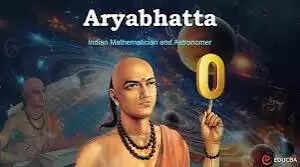
Born in 476 CE, Aryabhata showcased his exceptional talent in mathematics and astronomy from a young age. His seminal work, the Āryabhaṭīya, provides a window into his intellectual journey. In this work, Aryabhata intriguingly noted that in the year 3600 of the Kali Yuga, corresponding to 499 CE, he was merely 23 years old. This passing mention of his age underscores his extraordinary accomplishments at a youthful age, setting the stage for his illustrious career.
Aryabhata’s mathematical innovations were groundbreaking. He made significant strides in trigonometry and introduced the decimal system. Aryabhata’s notation for numerical representation played a pivotal role in the evolution of modern mathematics. Utilizing a base-10 system, which included the revolutionary use of zero as a placeholder, his innovation proved to be ahead of its time and profoundly influential in mathematical computations.
Aryabhata’s meticulous study of the solar system and celestial bodies was another hallmark of his work. The Arya-siddhanta, his second major treatise, delved into the realm of astronomy. In this work, Aryabhata presented a comprehensive understanding of the motion of celestial bodies. He meticulously calculated the Earth’s circumference, estimating it to be approximately 24,835 miles—an astonishingly accurate approximation given the historical context.
Aryabhata’s astronomical observations and calculations were revolutionary. He accurately explained the causes of lunar and solar eclipses, dispelling prevalent myths and superstitions. His research on the positions and movements of various celestial bodies laid a solid foundation for future astronomers to expand upon. Aryabhata’s systematic approach to studying the heavens significantly advanced the field of Indian astronomy.
One of Aryabhata’s most notable contributions was his explicit mention of the relativity of motion, a concept that would later become fundamental in modern physics. While his contemporaries largely adhered to static and geocentric views of the universe, Aryabhata challenged these notions. He postulated that the Earth rotates on its axis daily, resulting in the apparent movement of the stars and other celestial bodies. This remarkable insight into the relativity of motion anticipated the groundbreaking work of later physicists such as Galileo Galilei and Albert Einstein.
Aryabhata’s recognition of the Earth’s axial rotation and its implications for the apparent motion of celestial bodies showcased his keen observational skills and innovative thinking. His work paved the way for a more accurate understanding of the cosmos, and his ideas on motion laid the groundwork for future developments in physics.
In addition to his contributions to mathematics, astronomy, and physics, Aryabhata’s legacy extended to various other domains. He made strides in algebra, solving quadratic equations, and offering methods for solving indeterminate equations. His work also contributed to the study of planetary motion and eclipse calculation.
Furthermore, Aryabhata’s influence transcended geographical and temporal boundaries. His works were translated into numerous languages, including Arabic, Persian, and Latin, disseminating his knowledge and insights to distant corners of the globe. In the centuries following his lifetime, scholars from diverse cultures drew upon his writings, further advancing the progress of science and mathematics.
In conclusion, Aryabhata, the distinguished mathematician, astronomer, and physicist from classical India, occupies a prominent position in the annals of human intellectual achievement. His groundbreaking contributions in mathematics, astronomy, and physics laid the groundwork for future generations of scientists and scholars. Aryabhata’s insight into the relativity of motion, coupled with his remarkable mathematical and astronomical discoveries, continues to inspire and influence the pursuit of knowledge to this day.
About the Author